

The Staffordshire Hoard is one of the most significant archaeological discoveries in recent British history. It consists of a vast collection of Anglo-Saxon gold and silver artifacts, dating back to the 7th century. Unearthed in 2009, the hoard was discovered in a field near the village of Hammerwich, Staffordshire, England. This find has shed new light on the early medieval period, providing invaluable insights into the art, culture, and society of the Anglo-Saxons. In this essay, we will explore the Staffordshire Hoard in detail, discussing its discovery, contents, historical context, and its significance in enriching our understanding of the Anglo-Saxon world.
The Staffordshire Hoard was discovered by metal detectorist Terry Herbert in July 2009. While searching a farmer’s field, he came across a collection of gold and silver objects buried just below the surface. Recognizing the significance of his find, he promptly reported it to the relevant authorities. Archaeologists from the Birmingham Museums and the Staffordshire County Council were quickly mobilized to excavate the site, ensuring the artifacts were carefully and professionally recovered.
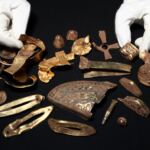
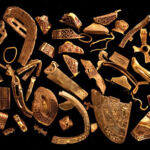
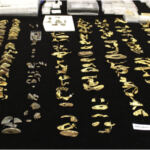
The hoard is composed of over 3,500 objects, most of which are made from gold, silver, or garnet, and it weighs approximately 5.1 kilograms. The items are predominantly military in nature, hinting at the martial society of the time. The most striking pieces in the hoard include:
The hoard contained several sword pommels and hilt fittings, ornately decorated with intricate patterns and inlaid with precious stones such as garnets. These items would have belonged to high-status warriors and provide insights into the sophisticated craftsmanship of the time.
Several parts of what are believed to be Anglo-Saxon helmets were also discovered. The intricate designs and the use of precious metals and gemstones suggest these helmets were likely used by elite warriors or leaders.
Among the artifacts were religious items, such as crosses and fittings from ecclesiastical objects. These objects suggest a complex relationship between the Anglo-Saxons and Christianity, which was a relatively new religion in the region during the 7th century.
Numerous objects related to military equipment were found in the hoard. These included fittings from shields, possibly from the shields of high-ranking warriors, as well as other objects used in battle.
The Staffordshire Hoard dates back to the 7th century, a time of significant cultural and political change in Britain. During this period, the Anglo-Saxons, who were Germanic peoples from present-day Denmark, Germany, and the Netherlands, had settled in Britain and established a number of kingdoms. The hoard is believed to have been buried in the Kingdom of Mercia, one of the most powerful Anglo-Saxon kingdoms during that era.
It is essential to note that the artifacts were buried during a time of political turmoil and Viking invasions. England was divided into several Anglo-Saxon kingdoms, and the threat of raids and conquests from Viking forces was ever-present. As such, the burial of valuable items like the Staffordshire Hoard may have been an attempt to protect them from being seized or desecrated during periods of conflict.

The Staffordshire Hoard is of immense significance for several reasons:
The artifacts in the hoard showcase the remarkable artistic skills and craftsmanship of the Anglo-Saxons. The intricate designs, inlays of precious stones, and metalwork techniques displayed in the objects provide valuable insights into the artistry of the time.
The hoard’s contents suggest a society with a warrior elite and a sophisticated network of craftsmanship and trade. It provides evidence of the connections between the Anglo-Saxons and other parts of Europe through trade routes.
The inclusion of religious objects in the hoard highlights the growing influence of Christianity in Anglo-Saxon England. It indicates a blend of traditional pagan beliefs with the emerging Christian faith.
The location of the hoard’s discovery, within the Kingdom of Mercia, provides insights into the political and military dynamics of the time. The artifacts suggest the wealth and power of the kingdom’s elite and may offer clues about the structure of early medieval Anglo-Saxon society.
The careful excavation and conservation efforts undertaken on the Staffordshire Hoard ensure that these artifacts are preserved for future generations to study and enjoy. It serves as a remarkable educational resource and a window into our past.
The Staffordshire Hoard has been extensively studied, conserved, and displayed in various museums across the UK. The most notable displays are at the Birmingham Museum and Art Gallery, and the Potteries Museum & Art Gallery in Stoke-on-Trent.
Since its discovery, the hoard has drawn significant public interest and has contributed significantly to research and understanding of the Anglo-Saxon period. It has also sparked interest in metal detecting as a means of contributing to archaeological knowledge, though this practice is tightly regulated in the UK to protect historical sites.
The Staffordshire Hoard is a treasure trove of Anglo-Saxon artifacts that has deepened our understanding of early medieval England. Its discovery has shed light on the art, culture, society, and religious practices of the Anglo-Saxons during the 7th century. The hoard’s artistic brilliance, historical context, and significance as an archaeological find have solidified its place as a national treasure and a vital part of British heritage. Through continued research and public display, the Staffordshire Hoard will undoubtedly continue to inspire and educate generations to come about this fascinating period in history.








Leave A Comment