
Thanksgiving 2020 officially starts on November 26th this year, the last Thursday of the month per tradition. For the day, most people will gather their families, eat, and watch the Thanksgiving Day parade or football. US residents are not the only people who celebrate the day, as Canadians, some of the Caribbean islands and Liberia also observe the occasion.
Thanksgiving as a tradition started more than 400 years ago when Pilgrims and Puritans emigrated to the New World from England in the 1600s.
Immigrants to the country brought with them their tradition of Days of Fasting and Days of Thanksgiving to the settlement of New England.
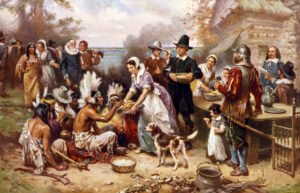
Thanksgiving Day itself can be traced back to one event in the settlement during 1621 when pilgrims hosted a feast for Native Americans as a way of thanks for helping them through a bitter winter.
Pilgrims met with Native Americans at Plymouth in modern-day Massachusetts and shared with them the fruits of the summer’s harvest.
Americans commemorate this day every year by hosting a meal for friends and family, with each attendee expected to contribute a dish.
With the family gathered around the table, custom dictates people list what they are thankful for in their lives.
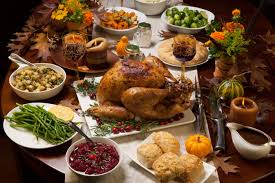
Typical Thanksgiving dishes include bread stuffing, cranberries, potatoes, pumpkin pie, and, of course, the famous Thanksgiving turkey
Eating turkey is a tradition thought to extend back to the first Thanksgiving in Plymouth.
The pilgrims are thought to have supplied wild “fowl” during the meal, which may have been a plump Turkey.
However, while scholars have determined there was a meal shared between the Plymouth colony and local Wampanoag Indians, there is no evidence of Turkey.
The modern tradition of eating Turkey became commonplace long after the first Thanksgiving, generally because of availability.
According to Encyclopaedia Britannica, there were as many as 10 million turkeys in the US when Europeans started to make contact, making them the most easily accessible meat.
Many of these turkeys lived on family farms, making them easy to slaughter.
They are also large birds perfect for a hearty meal, with the average turkey weighing in at 30lbs, three times the weight of the average chicken at 10
In modern-day America before Thanksgiving, tradition dictates one turkey is ‘pardoned’ by the president.
Each year, the president will stand aside one special turkey outside the Whitehouse and pardon it on behalf of all turkeys.
The tradition stretches back to 1863 when Abraham Lincoln’s son Tad pleaded him to spare the life of one turkey.
Turkeys pardoned by the President are spared and sent to live out the rest of their days without fear of hungry Americans on a farm.
Thanksgiving Day is a day for people in the US to give thanks for what they have. Families and friends get together for a meal, which traditionally includes a roast turkey, stuffing, potatoes, vegetables, cranberry sauce, gravy, and pumpkin pie.
In some cities and towns, there are parades during the Thanksgiving weekend. In most areas, these festivities also mark the opening of the Christmas shopping season.
The Day After Thanksgiving, also know as Black Friday, is a holiday in more than 20 states. It’s common to take trips and visit family and friends during the long weekend.
Most government offices, businesses, schools, universities, colleges, and other organizations are closed on Thanksgiving Day. Many offices and businesses allow staff to have a long four-day weekend for Thanksgiving, so these offices and businesses are also closed on the Day after Thanksgiving Day. Public transit systems usually do not operate on their regular timetables.
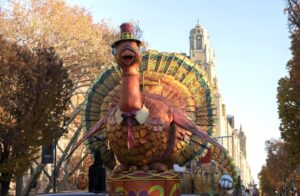
Thanksgiving Day is one of the busiest periods for travel in the USA. This can cause congestion and overcrowding. Seasonal parades and busy football games can also cause disruption to local traffic. Sadly in 2020 due to the COVID pandemic, this will not be the case.
Thanksgiving Day has been an annual holiday in the United States since 1863. However, not everyone sees Thanksgiving Day as a cause for celebration.
Beginning in 1970, a group of Native Americans and their supporters have staged an annual protest for a National Day of Mourning at Plymouth Rock in Plymouth, Massachusetts on Thanksgiving Day. American Indian Heritage Day is also observed at this time of the year.
There are claims that the first Thanksgiving Day was held in the city of El Paso, Texas, in 1598. Another early event was held in 1619 in the Virginia Colony. Many people trace the origins of the modern Thanksgiving Day to the harvest celebration the Pilgrims held in Plymouth, Massachusetts in 1621. However, their first true thanksgiving was in 1623, when they gave thanks for rain that ended a drought. These early thanksgivings took the form of a special church service, rather than a feast.
In the second half of the 1600s, thanksgivings after the harvest became more common and started to become annual events. However, they were celebrated on different days in different communities and in some places there were more than one thanksgiving each year. George Washington, the first president of the United States, proclaimed the first national Thanksgiving Day in 1789.
From us all at the Archaeology and Metal Detecting magazine – Happy Thanksgiving where ever you are.


Leave A Comment