
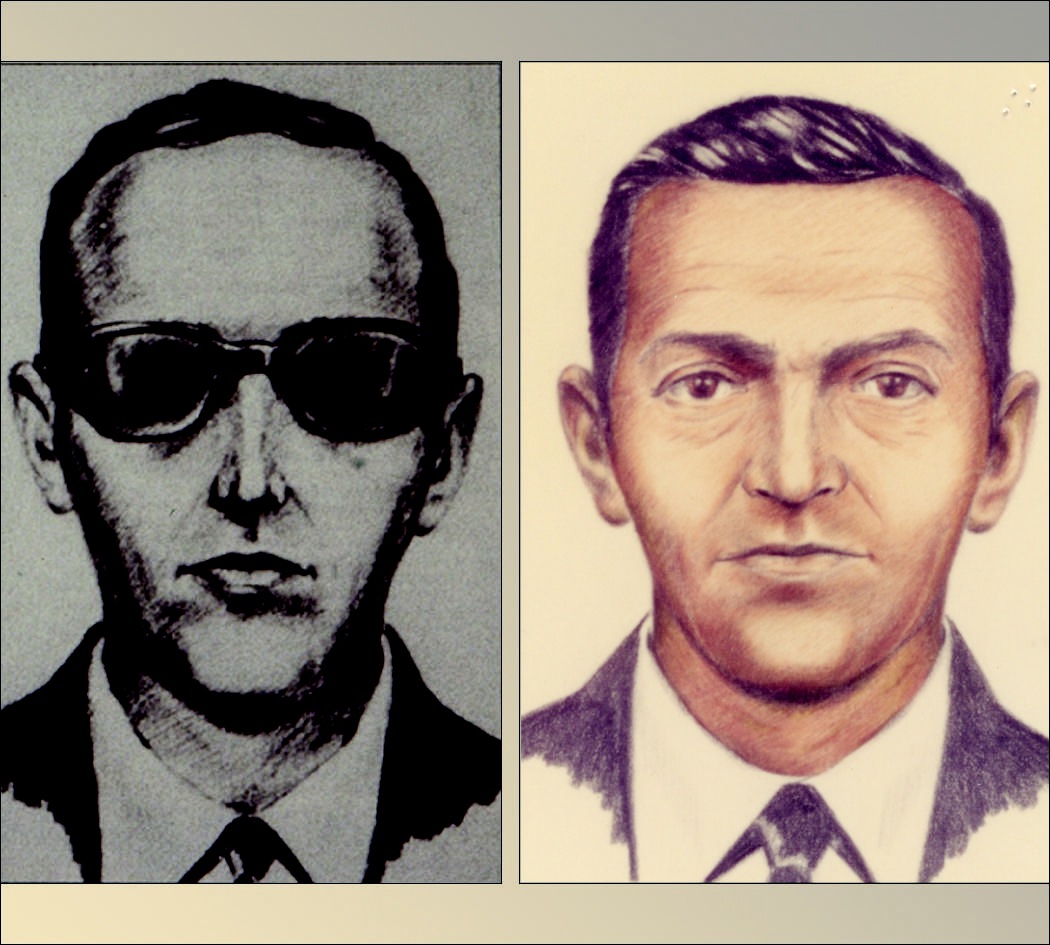
“D.B. Cooper” is the now infamous alias for an airplane hijacker who took over a Northwest Orient Airlines flight in 1971. Cooper, a quiet man estimated to be in his mid-40s, wearing a business suit, boarded the short flight from Portland, OR, to Seattle, WA, and ordered a bourbon and soda. He then passed a note to a flight attendant telling her he had a bomb onboard.
Cooper showed her what appeared to be an incendiary device in his briefcase, and then gave his demands: He requested four parachutes and $200,000 in $20 bills. The plane circled Seattle as Cooper’s ransom was readied. Upon receiving the money and requested equipment, he let the unsuspecting passengers disembark, but forced several crew members to stay onboard and take him to Mexico City. Another odd request? They were to fly the plane under 10,000 feet.
At this height, over Southwestern Washington, Cooper jumped off the back of the airplane with the money. The FBI believes Cooper probably didn’t survive the jump because he would have parachuted into remote wilderness in poor weather conditions without proper equipment, and his use of the equipment he did have led them to conclude he wasn’t an experienced skydiver. Those who believe he did survive point to the fact that none of Cooper’s equipment (nor his body) have ever been found despite extensive searches.
Adding to the mystery, in 1980, about $6,000 of Cooper’s ransom money was found buried in the banks of the Columbia River. It’s the only money of the $200,000 that has ever been located. An amateur crime historian named Eric Ulis believes that the remaining money is located in the same vicinity, and that the FBI was actually looking for Cooper (and any evidence from his jump) in the wrong area.
After 45 years, the FBI still hadn’t managed to solve the case of D.B. Cooper, or even identify him. In July 2016, the FBI officially decided to suspend active investigation of the case due to insufficient evidence pointing to his identity or the missing money.
Still, many people have come forward over the years claiming to know Cooper’s true identity. Some theorize that Cooper was a former Boeing employee, giving him a knowledge of airplane mechanics. Others have suggested Cooper was Robert Rackstraw, a former Army helicopter pilot. Alternatively, many believe the woman who came forward stating Cooper was her uncle and that he had plotted the whole thing at a family gathering in 1971. Though the list of potential suspects is long, no one has been able to definitively prove which one (if any) was Cooper.



Leave A Comment