

on 18th September 2021, I was up early with my brother David and I for the 60-mile drive to Leek in Staffordshire to meet up with Tony Cummins and the guys from Midland Detecting Days.
In the notice on the dig, Tony had mentioned the area we were detecting was once owned by a George Fearns, an infamous forger who was hanged in 1801 at Staffs Gaol.
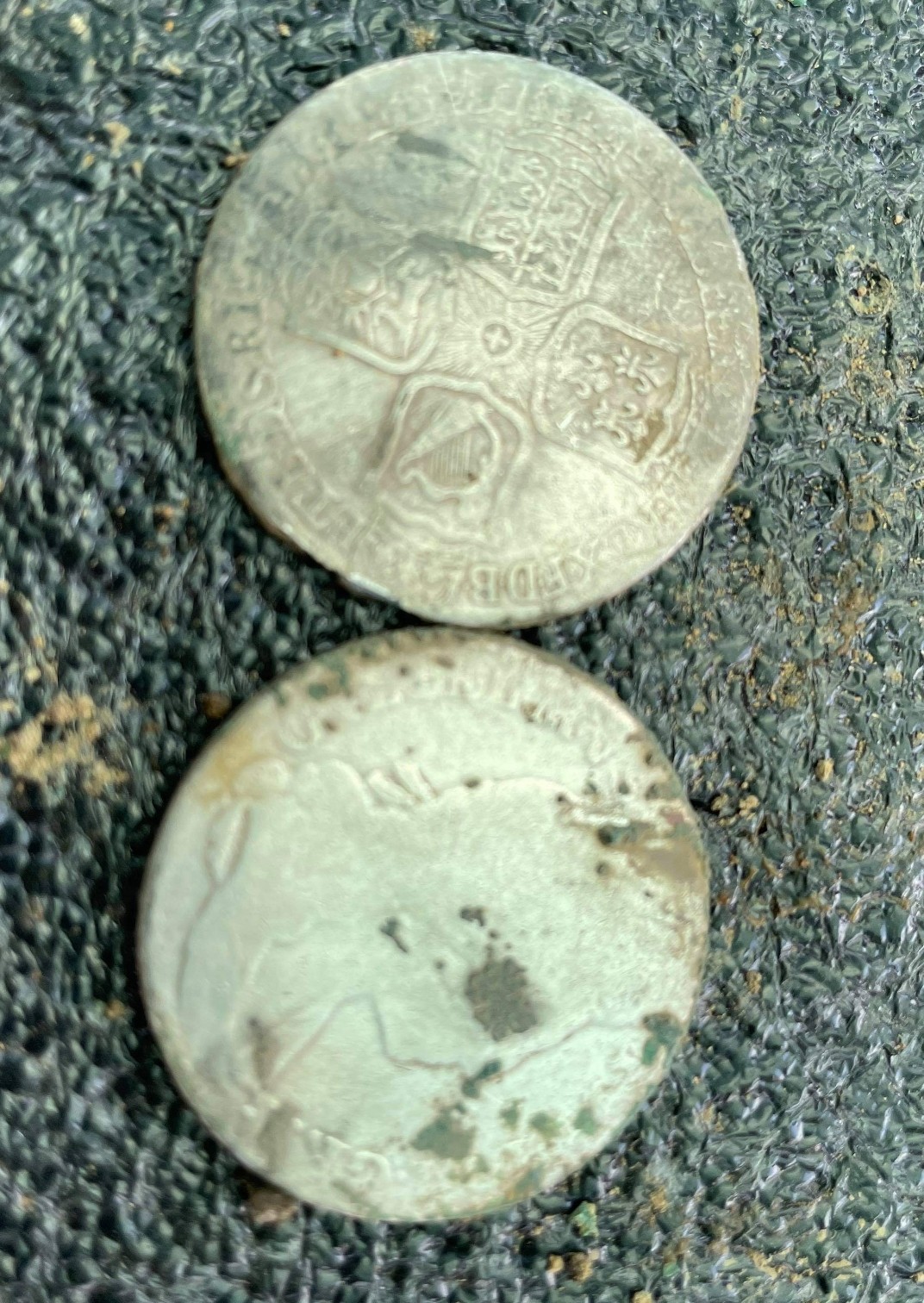
Out 0f the car and away, two feet onto the field and I hit a coin, looks like a George II but don’t seem right. Within 20 minutes Tony told us of a forger’s die had been found in another field. David then found a crucible in the field we’re working and dropped it in his pouch thinking it was junk. No more finds on this field so we move to another about 400 yards away, detectorists had been on this field for a couple of hours and the place we decided to dig had about ten detectorists swinging away. I noticed the wall at the end of the field that looked very old but the grass was about a foot deep. I pointed out near to the old wall what looked like staining in the grass like it once had a building. So we made a start there and after a few swings around this square it brought up 3 coins and five buttons within minutes.
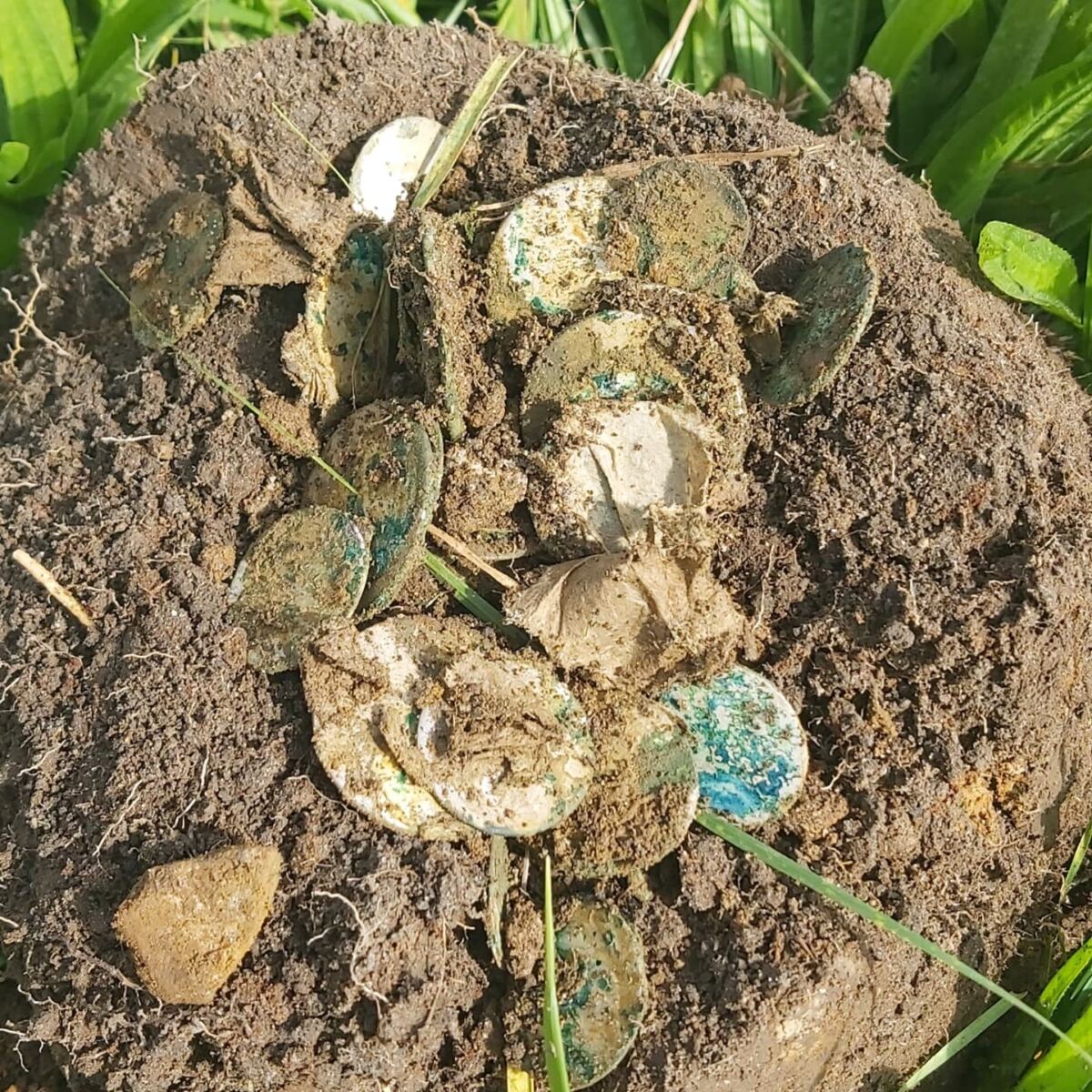
I told David I was moving away as the grass was too long, so he went one way and I the other. We were about 20 feet apart when I stopped to film a Pullman train passing and on putting my detector down it hit a solid 91 on the XP Orx. When the train had passed and I stopped filming I picked up the Orx and heard the same signal, I dug a plug out and the number was the same so I called David over and he hit the same on his XP Deus. I said that it had to be a big copper coin, so I went down about ten inches and was about to give up, thinking deep iron, when I spotted a tiny round edge shape in the bottom of the hole, I flicked it with my finger and it was attached to about another ten small circles of metal.
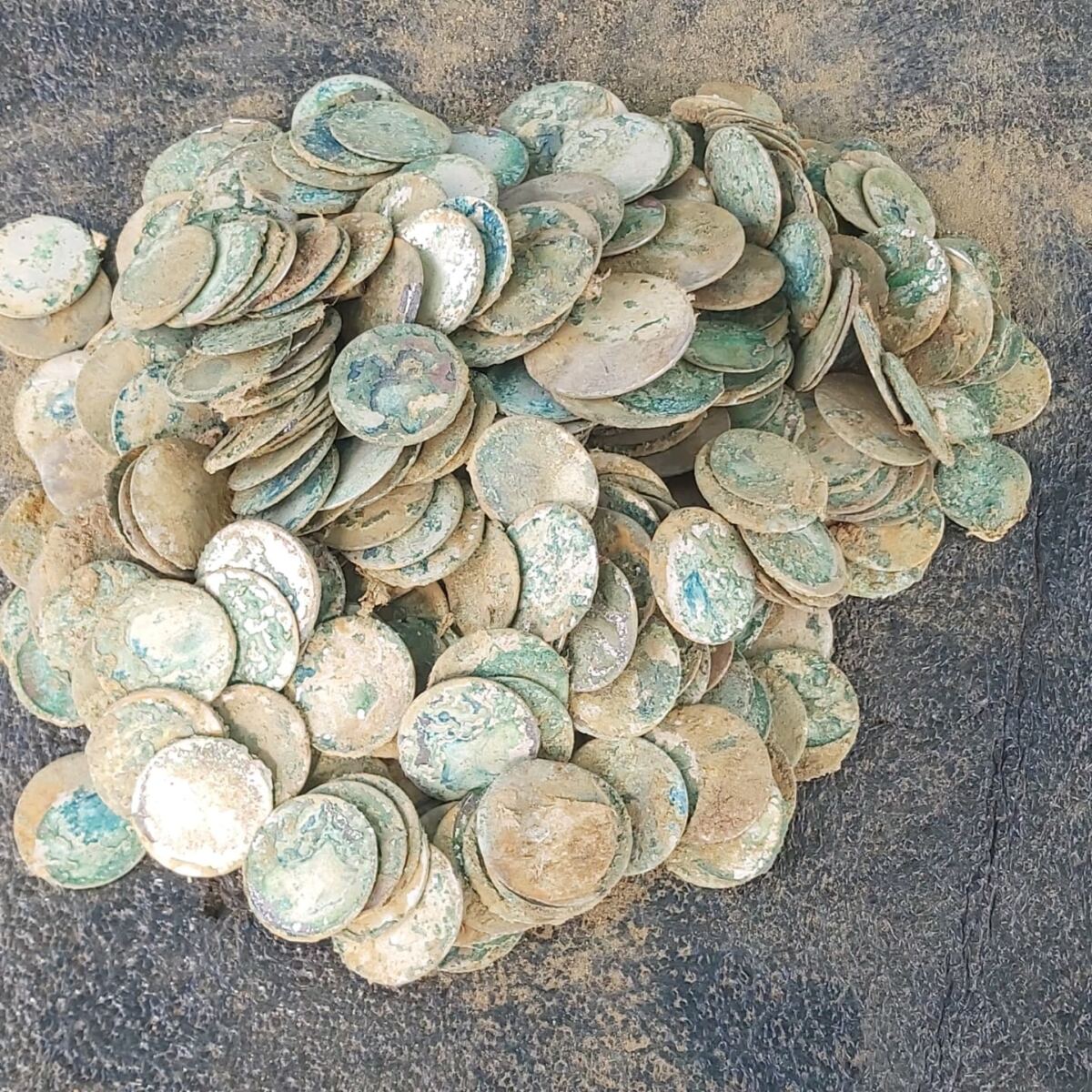
After pulling out about another fifty and laying them on David’s rucksack. We noticed the faces and reverses of William III coins so I called Tony on the phone and told him to drive over to the field as we think we have a hoard. Tony arrived and they just kept coming out, some were wrapped in paper.
Tony cordoned off the area as other detectorists started to gather watching what was happening and we continued. The hole was perfectly round, about six inches across and almost eighteen inches down.
When we were sure that all the coins were out we packed the coins and what paper was left into the rucksack and walked back to the finds table where admin and others laid them out to count. David pulled out the chunk of iron he thought was junk and went to throw it in the bin next to the table when Tony stopped him and told him what it was. A crucible is for making the beginning of the coins, I wonder how many times in the past detectorists have done that!
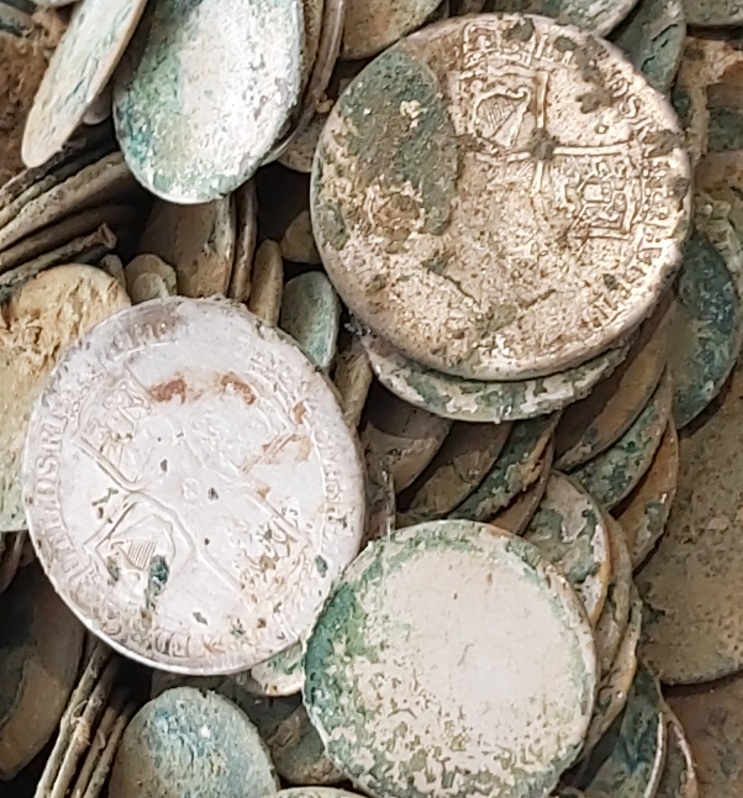
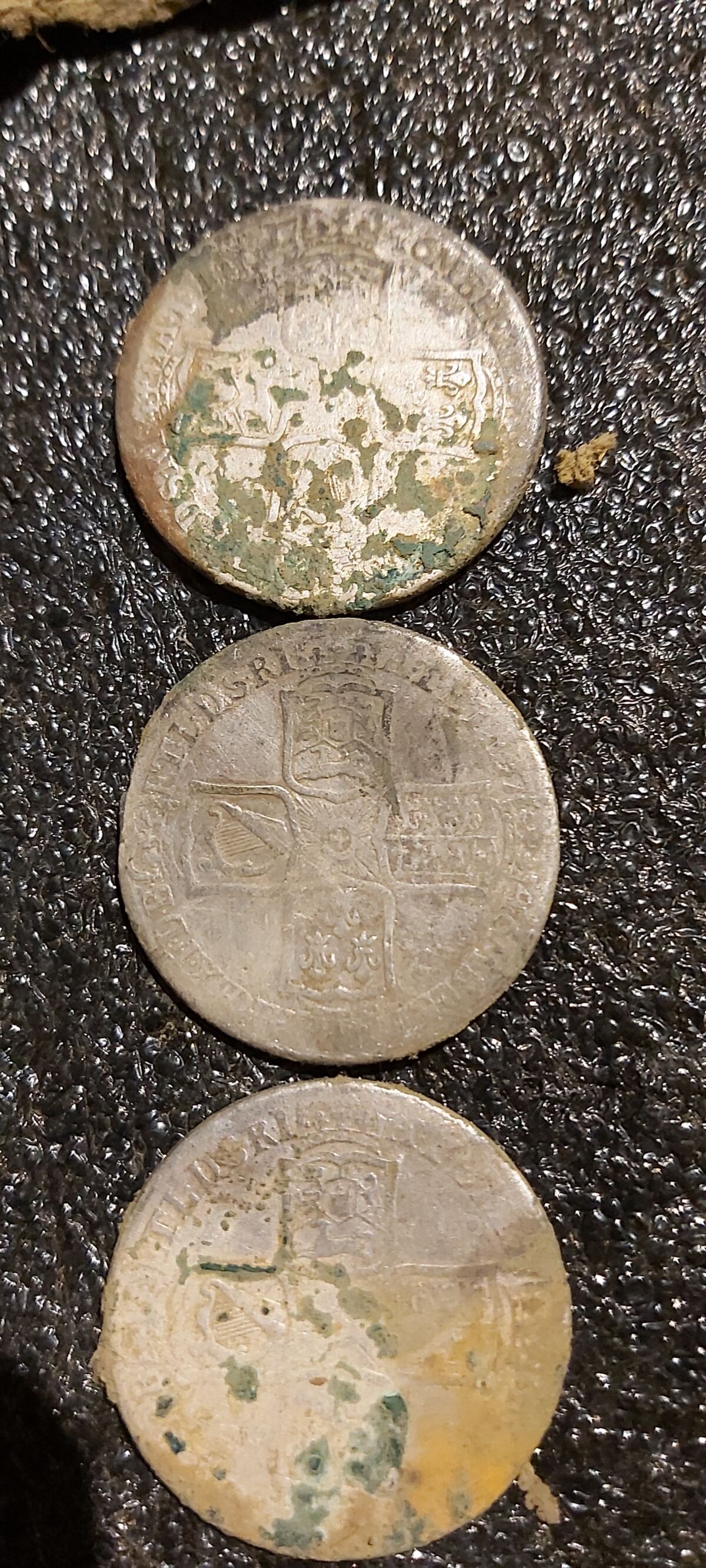
They were Half Crowns, Shillings and Sixpences. 332 coins altogether and most were toasted, but were obviously forgeries, but Tony noticed something really strange. The faces on the coins were William III but the reverse were George II all dated 1746.
Tony contacted the FLO (Finds Liason Officer) and we arranged the following Tuesday to sit down with the landowners and tell them the news of what would happen next.
Since that meeting, the FLO has declared them as treasure under the Treasure Act 1996 and informed the coroner, a normal procedure here in the UK. As I write this, the hoard is currently being catalogued and the paper being sent for analysis as it is now thought the paper is in fact forged banknotes. The paper used back then contained lots of linen etc and could be the reason why it survived being underground for so long.
The FLO asked us to return to the spot where I found the coins and search for more paper. I only found a small corner that had a green tint and possibly some writing, this was again handed over.
As we wait for more news we understand that Hanley, Birmingham and the British Museum are all showing an interest in acquiring this hoard as the previous largest forgery hoard was of 92 coins which are currently at the BM.
I would hope that they stay at the Hanley Museum as it is only a few miles from where they were recovered for the local people to view.

The research and the forger
After lots of help from researchers and particularly Gary Oddie from the British Numismatic Society, we were able to put together a good deal of information regarding the forger George Fearns.
Taken from the book “Capital Crimes” our story begins on page 69 entitled! “A False Note, George Fearns of Bottomhouse”
Ross Prince explains:
“Dealing in counterfeit banknotes was a very lucrative business, but to be caught passing a forged note was a capital offence. Many people chose to take the risk, however, and the whole business was a great problem to the law enforcement agencies. The Bank of England had been tipped off that a certain George Fearns of the pub at Bottomhouse, about four or five miles from Leek, had been passing forged notes, and so they arranged for him to be investigated…”
On July 1st 1801, arriving at 11 pm, two undercover policemen who were disguised as hawking peddlers proceeded to ‘set up’ Fearns. In their conversations that night and the next morning, Fearns made the statement that it was bad times and a man had to work hard to live honestly.
The officers ordered milk and rum at breakfast and after commenting that the milk was delicious they mentioned the rum was not of good quality.
Sensing that Fearns was probably interested in other dishonest practices besides forging banknotes, the officers asked Fearns if he would like some cheap rum which they could supply at 6 shillings to 6 shillings and sixpence a gallon. Hidden and packed hard in flour barrels.
Fearns took the bait!
The officer then put down a forged Halifax One Guinea note and asked Fearns if it was well done. He was obviously experienced in this field and said that it was a forged one, and thought it was a bad one at that. They then produced some Bank of England notes, the undercover officers saying that they had never seen better.
“What do you give for a pound screeve?” (A forged banknote) asked Fearns.
The officer replied “8/6d for the £1 note and 14 shillings for a £2 note.”
Fearns then produced £5 and £10 screeves, saying proudly, “Look at yours and look at mine” adding that he had paid £1 and ten shillings for the £5 note.
Fearns proceeded to show the officers how to wear the notes to give an appearance of age using a sweaty palm and to only rub the note one way and never to crush or attempt to age the note in any other way.
Having proved that Fearns was in possession of, and had passed forged notes, one of the officers slipped out of the pub and raced to Leek to get the local constabulary to come and arrest Fearns.
They did so, and the following morning he was committed to Stafford Gaol.
When his case came to court, Fearns’ defence counsel put forward all manner of technicalities to try and prove him not guilty, and Fearns himself tried to deny everything, claiming he knew nothing of the notes in question, he did not sell them and furthermore had witnesses that he did not.
It is here that James Bloor enters the proceedings. Bloor, a baker living near the Inn, said that he had been there the whole time, and no such conversations or transactions had taken place. However, his story was not believed by the court.
The jury found Fearns guilty and Bloor was charged with perjury. The judge said he liked perjurers no more than he liked screevers (forgers) and the law must take its course.
George Fearns was executed on August 8th 1801, for uttering three bills knowing them to be forgeries of the Bank of England.
On April 3rd 1802, at Stafford Assizes, James Bloor was sentenced to be transported aboard a ship to Australia for seven years, for his perjury.
And that is the story of how I found 332 silver forged coins over 250 years old of a convicted forger in a field in Leek, Staffordshire, England
John McGimpsey ( The Toffee Digger )



Leave A Comment