

March 17 is St. Patrick’s Day. It’s the one day each year that everyone and anyone calls themselves Irish – if not by birthright, then in spirit. Here we share a thing or two about how a religious feast day commemorating the famed Irish patron saint who brought Christianity to Ireland ended up being a day celebrated almost globally, usually involving copious amounts of Guinness.
St. Patrick’s Day is celebrated in more countries around the world than any other single-day national festival.
The luck of the Irish and all things green is celebrated on St. Patrick’s Day on March 17 every year. Initially a day to honour patron saint St. Patrick of Ireland, over time the holiday has evolved into a fun and festive celebration of Irish culture.
Magonius Sucatus Patricius was a British man who was kidnapped by Irish raiders when he was 16. He ended up spending six years in captivity in Ireland – it was during that time that he became a devout Christian. He escaped eventually, believing God told him in a dream that he was to leave Ireland. So he walked to the coast, hopped on a ship and returned home. There, he dreamed that an angel told him to return to the Emerald Isle as a missionary. St. Patrick spent more than 15 years studying religion before becoming ordained and returning to Ireland. He died around 461 AD.
The Catholic Church first recognized March 17 as a feast day commemorating Ireland’s best-known and most beloved patron saint, Saint Patrick, in 1631. With rare exception, March 17 always fell during the Christian holy season of Lent.
Most sources point to his “Confessio” as one of the only documents we know to have definitely been written by him.
According to legend St. Patrick drove the snakes out of Ireland. However, today we understand that Ireland is snakeless because of its climate and the water that surrounds it is too cold for British snakes to migrate over. The snakes are believed to be symbols for the pagan religions.
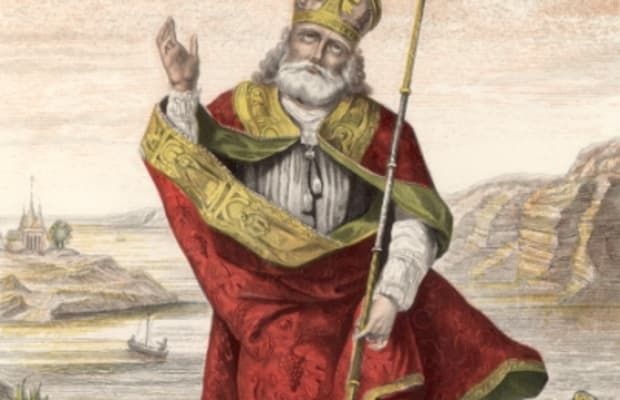
Saint Patrick’s feast day in Ireland remained a traditionally pious religious day. Irish laws eventually curtailed the use of alcohol during the feast on March 17 by mandating that all pubs remain closed on that day. This was Irish law until it was repealed in the 1970s. The day continued to be and still is observed as a feast day by the Church of Ireland, the Catholic Church, the Anglican Communion, the Eastern Orthodox Church and the Lutheran Church.
Meanwhile in America, more than one million Irish men, women and children were immigrating through Ellis Island in the 1800s. They faced oppressive discrimination in America, leaving most unemployed and living in severe poverty in New York City tenements. As their numbers grew the Irish discovered strength in unity and rallied together to celebrate their beloved patron saint with a parade every March 17. The practice of St. Patrick Day parades and festivals followed Irish immigrants as they made their way across America’s heartland and into the deep south seeking cheap farmland and job opportunities.
Erin go Bragh!






Leave A Comment